
'There are so many dimensions to history that we need to attend to: We need more space for local and regional histories; we need to delve into the histories of particular communities; we need to emphasise gender history and environmental history.' 'We need to think about India's history beyond India's current borders.'

Nearly two decades ago, then defence minister George Fernandes said: 'China has built roads up to the border, while there has been negligence on India's part.' Since Fernandes uttered these brave words, what has been done on the Indian side? The Modi Sarkar is apparently trying, but little has been achieved so far, says Claude Arpi.

'This is a new phenomenon,' says Shekhar Gupta. 'Does it point to the rise of egomania, and could it also be a reason our politics is broken and Parliament non-functional? Where our biggest leaders talk not to, but at each other.'
The major driver of Mod's foreign policy can be gauged from his economic priorities such as creating employment opportunities for the youth bulge. Related to this is emphasis on manufacturing, and infrastructure development, which in turn raises the issue of FDI. He has already articulated his views on all these issues, says Rup Narayan Das.

'China made it evident that neither the swing-ride at Ahmedabad nor the red carpet at New Delhi worked, by timing its muscle-flexing in Ladakh to coincide with Xi's visit.'

Despite vast differences in the way the media operates in the two countries, an India-China media forum will go a long way in improving understanding between the two countries, says Srikanth Kondapalli.

Sparks flew in the Lok Sabha on Wednesday as the raging Jawaharlal Nehru University row and suicide of Dalit student Rohith Vemula was taken up for discussion, with opposition accusing the government of muzzling the voice of the youth and "mercilessly crushing" the principles of democracy.

'Disparity is not only in Mumbai; you see it in every city. The other day, I saw right next to the mansion of Mukesh Ambani worth Rs 5,000 crore for one family, thousands of people sleeping on the pavement. This is the urban India you have created!'

Why Dalit leaders cross over to the BJP

Enormous debt isn't the only thing afflicting Air India. Its work culture is an equal culprit in its downfall.

After many false starts, India may well be at the inflexion point that Deng Xiaoping took China to post-1978. The window of opportunity is wide open right now, says Rajeev Srinivasan.
The State is trying to curb the students movements, therefore, there are suspicions against some of the Subramanian report on education's recommendations, says Mohammad Sajjad.

'What if Modi becomes the fascist the leftists paints him as? What if he does suspend the Constitution and declares himself the ruler, with support from the army? What exactly will you do, Mr Leftie?' asks Rajeev Srinivasan.

It is rare for communal riots to spread to rural areas. The UP riot is the first time after the September 1969 Gujarat riots that a rural area have been affected. Electoral politics which divide society in majority/minority, going on since the early 1990s, is a major contributing factor to this heightened tension between communities, says Colonel (retd) Anil Athale in the first of a two part series.
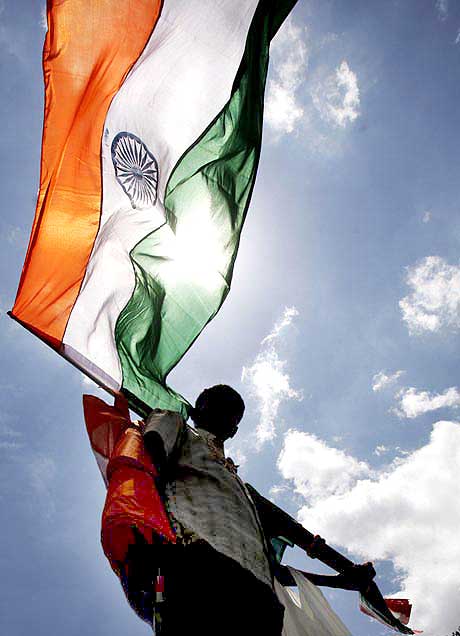
How has the Indian State, in principle and practice, given shape to the essential ingredients of the secular principle and composite culture?
.jpg)
It's perverse to rationalise 'controlled' killings or torture -- without going down a slippery moral slope. Once the state stoops to torture, it's liable to sink into tyranny, says Praful Bidwai.
Attorney General Mukul Rohatgi's stand that AMU is not a minority university reveals the anti-minority stand of the political party now in power, says Mohammad Sajjad, outlining the long history behind one of India's premier universities.

Shopkeepers are losing buyers in droves to e-tailers for everything from fashion to smartphones, and are struggling to find solutions.

'The consolation is that in recent years, the focus at the time of the anniversary has been increasingly shifting from Indira Gandhi's assassination to the plight of the thousands of innocent Sikhs who had been killed in retaliation,' Manoj Mitta, co-author of When a Tree Shook Delhi: The 1984 Carnage and its Aftermath, tells Prasanna D Zore/Rediff.com.

'... A youth movement which could really transform our politics in a way that the existing elites don't understand.' 'The more you suppress free expression, the more people will value it.' 'The State can't suppress a young society like India where there are so many interesting new ideas emerging,' says Sunil Khilnani, whose latest book Incarnations looks at Indian history through 50 lives.
